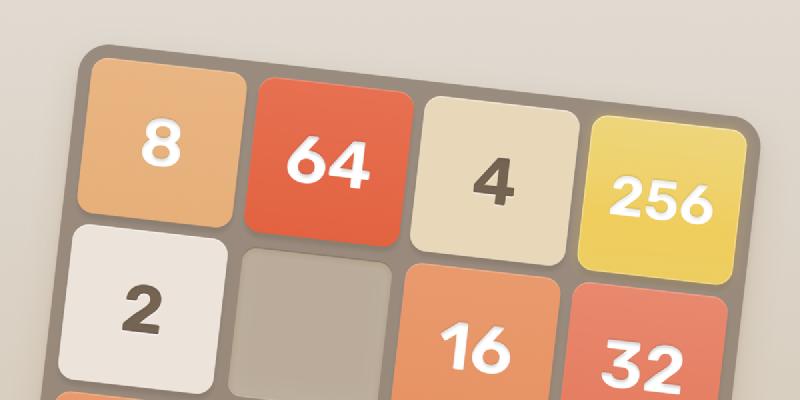
I used this project as an introduction to Reinforcement Learning. Having mostly worked with supervised and unsupervised learning, I wanted to start with a small, simple project to quickly grasp the main ideas and create something fun. I followed this YouTube video as a reference, which explains how to use Reinforcement Learning (RL) to train a model capable of playing the snake game. To make it more challenging, I applied the same network to the 2048 game.
Code
The code has three main components:
- The Game: Implements the game logic and the graphical user interface (GUI).
- Agent: Controls the gameplay.
- AI Model: A neural network that learns how to play and guides the agent.
Game State
I modeled the game state as a 4x4 matrix representing the board. The actions in the game are represented by a vector, with the following possibilities:
- Left: [1, 0, 0, 0]
- Right: [0, 1, 0, 0]
- Up: [0, 0, 1, 0]
- Down: [0, 0, 0, 1]
Reward
The RL model works with rewards to quantify when the agent performs well or poorly. Initially, I defined the following rewards:
- +10 points: When the agent doubles the points. This is crucial because, in 2048, points increase exponentially.
- -10 points: When the game is lost. This serves as a straightforward negative reward.
Initially, the model showed slow improvement. To address this, I added an additional reward:
- +2 points: When points are increased. This reward incentivizes actions that maximize board clearance and progress.
How the Model Works
The model is a simple linear neural network. It takes the game state as input and predicts the best next action to maximize the reward.
Rewards are managed using a technique called Q-Learning. A Q Value represents the quality of a decision based on the loss function. The loss function is derived from the Bellman Equation:
$$ NewQ(s, a) = Q(s, a) + \alpha [R(s, a) + \lambda \, \text{max}Q'(s', a') - Q(s, a)] $$Where:
- $Q(s, a)$: The Q Value for a specific state and action.
- $\alpha$: Learning rate.
- $R(s, a)$: Reward for a specific state and action.
- $\lambda$: Discount rate.
- $\text{max}Q’(s’, a’)$: Maximum expected future reward.
Experiments and Results
Random Test as a Baseline
To establish a baseline, I tested the average score achievable by taking random actions. After 1,000 iterations, the average score was 170, far below the 2048 points needed to win the game.
Initial Results
My initial attempts were discouraging. The model performed worse than random movements. Here are some early results:
- Game 1,000 | Score: 208 | Record: 416 | Mean Score: 200 | Reward: 640
- Game 1,000 | Score: 116 | Record: 346 | Mean Score: 161 | Reward: 310
- Game 1,000 | Score: 112 | Record: 348 | Mean Score: 146 | Reward: 320
In these attempts, the agent developed a suboptimal strategy of filling the board before increasing points.
Improvements
After experimenting with the reward parameters, I focused on the exploration phase. Initially, the exploration games parameter, which randomly picks moves, was set to 25 games. Increasing this parameter allowed the agent to explore more strategies, leading to better results:
- Game 1,000 | Score: 478 | Record: 478 | Mean Score: 230
- Game 1,000 | Score: 514 | Record: 964 | Mean Score: 382
As the model improved, I extended the training to more games:
- Game 3,796 | Score: 770 | Record: 1,366 | Mean Score: 469
- Game 4,852 | Score: 631 | Record: 1,462 | Mean Score: 483
Finally, with 200 exploration games and 5,000 training games, the results were as follows:
- Game 5,000 | Score: 840 | Record: 1,678 | Mean Score: 512
Although the model didn’t beat the game, I was satisfied with the progress. I believe that with longer training (the final run lasted 4 hours) and additional network layers, it would be possible to win the game using this architecture.
Demo
Here is a demo of the application, showcasing the agent’s learning process:
I implemented keybindings to control the game’s speed, providing three options:
- Fast: For rapid training.
- Slow: To observe and analyze the agent’s progress and mistakes.
- Medium: Rarely used.
The complete code for this project is available in this repository.